
Life and Work of Ybyrai Altynsarin
(1841–1889)
Ybyrai Altynsarin was born on October 20, 1841 (Old Style) in the Arakaragay volost of the Nikolaev district of the Turgay region (now Zatobol district, Kostanay region).
His father, Altynsary, was a modest and calm man who had not received a systematic education beyond studying with a village mullah. After his death in 1844 at the hands of detachments of Kenesary Kasymov, Ybyrai’s mother, Aiman, remarried her late husband’s younger brother, Koshan. Descendants of this line still live today (including poet Mariyam Khakimzhanova, scientist Shabden Balgozhin, and others).
Ybyrai’s upbringing and education were entrusted to his grandfather, the biy Balgogha. On March 5, 1846, Balgogha personally traveled to Orenburg and submitted a petition to the chairman of the Border Commission, Major General M. V. Ladyzhensky, requesting the admission of Ybyrai to a newly planned school for Kazakh children. The request was granted.
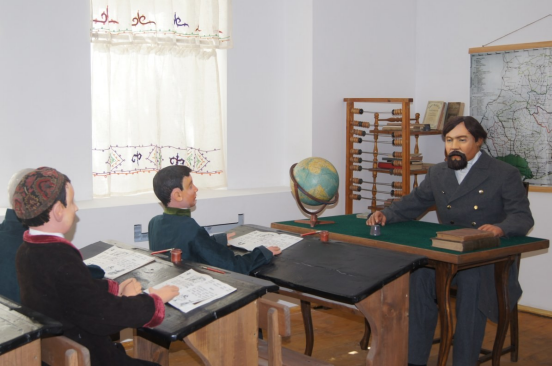
On August 22, 1850, a special school for Kazakh children was opened under the Border Commission in Orenburg. The course of study lasted seven years. The school was housed in a beautiful single-storey brick building on a street called “Bolshaya.” Classes began on August 24. Ybyrai was among thirty students admitted, and it was there that he first took a pen in his hand.
The curriculum included Russian, Kazakh, and Tatar languages, drawing, geometry, arithmetic, geography, and history. Students were also trained in clerical work, investigative procedures, and basic first aid. Religious instruction covered both Christian and Islamic teachings.
On June 15, 1857, twenty students graduated. Ybyrai was among the five best graduates and received an official certificate.
His seven years of study and exposure to Russian intellectual circles in Orenburg opened wide opportunities for his intellectual and spiritual development.
Between 1857 and 1859, Ybyrai worked as a clerk for his grandfather Balgogha. In 1858, he was granted the rank of junior cornet.
From August 1, 1859, he served as a junior translator in the Orenburg regional administration under the chairman of the Border Commission, the distinguished orientalist and scholar, Lieutenant General V. V. Grigoryev.
During this period, Grigoryev—who held Balgogha in high esteem and was well disposed toward Altynsarin—provided the young man with significant support in his self-education and intellectual growth. Through him, Ybyrai became acquainted with the prominent orientalist N. I. Ilminsky, with whom he later formed a close friendship.
In 1860, the Orenburg administration received permission to open a primary school for Kazakh children at the Turgay fort. Ybyrai Altynsarin was appointed as the teacher of this school and arrived in Turgay in July of that year.
However, the school could not be opened immediately, and Altynsarin temporarily continued working as a translator at the fort command. During this time, he did not remain idle: he took several students into his home and began teaching them himself. In a letter to N. I. Ilminsky dated November 18, 1860, he wrote that he already had pupils living with him and was continuing their instruction.
Between 1861 and 1863, Altynsarin worked on the establishment of a one-class school in the Turgay fort, focusing primarily on constructing a school building. Organizational work gradually progressed.
At that time, the fort was commanded by Captain Yakov Petrovich Yakovlev, who supported Altynsarin’s educational initiatives, and a friendly relationship developed between them. An important role was also played by the Orenburg official Alexey Alexandrovich Bobrovnikov, who was well disposed toward the Kazakhs and had informed Yakovlev in advance about Altynsarin’s activities, urging him to provide support.
Altynsarin traveled across the auls of the Turgay steppe collecting funds for the construction of the school and wrote letters to acquaintances in Troitsk requesting building materials. In 1862, he received textbooks sent by his mentor and friend N. I. Ilminsky, including a Russian language self-instruction manual for Kazakhs. That same year, the number of his pupils reached four.
He was especially pleased with the book “Er Targyn,” published by Ilminsky.
During these years, Altynsarin became acquainted with the work of the prominent Russian educator K. D. Ushinsky, “The Children’s World,” which he highly valued. In a letter to Ilminsky in 1862, he wrote that such books were extremely useful for translation and that traditional religious schoolbooks in Arabic, Tatar, and Persian hindered intellectual development. He emphasized the need for literature in a language understandable to Kazakhs.
By the end of 1863, Altynsarin completed the construction of the school, designed according to his own project, and informed the Orenburg authorities that it was ready to begin systematic instruction.
On January 8, 1864, the Kazakh school in Turgay was ceremonially opened with the participation of local residents, accompanied by traditional festivities and horse races. Thirteen students were enrolled at once.
In 1865, the students took their first examinations, and four of them received awards. Altynsarin presented them with educational books, including works on nature, animal life, and astronomy.
In the same year, he was promoted to the rank of cornet for his successful organization of the educational process.
From 1866 to 1868, he continued teaching, occasionally performed judicial duties in the district, and during the absence of Captain Yakovlev, temporarily managed administrative affairs. At the same time, he actively promoted enlightenment ideas among the population.
In 1869, at his initiative, the four-year Kazakh school in Turgay was transformed into a Russian-Kazakh school.
Following the administrative reform of 1868–1869, the Turgay region was reorganized into districts. Altynsarin participated in these transformations, including administrative and judicial work, and fought against abuse, corruption, and injustice. Nevertheless, regardless of his official position, he regarded education as his primary mission and devoted himself to it with full commitment.
In 1870, his ethnographic works were published in the Proceedings of the Orenburg branch of the Russian Geographical Society. That same year, he began correspondence with N. I. Ilminsky regarding the use of the Russian alphabet for the Kazakh language.
He argued that schools were the main means of enlightenment and that education required a systematic and consistent approach.
In 1873, he became a member of the Russian Geographical Society.
In 1874, following the death of the district judge P. Plotnikov, he was temporarily appointed to the position.
In 1876, during a meeting with Minister D. A. Tolstoy, he expressed his full dedication to public education rather than administrative service.
In 1879, he was appointed inspector of schools in the Turgay region. In the same year, he published the “Kazakh Chrestomathy” and a manual for teaching Russian to Kazakhs, both written using the Russian alphabet to represent Kazakh speech.
These works became a significant pedagogical legacy and remain valuable to this day.
In 1881–1883, he expanded the school network, opening schools across all districts and establishing the first craft school in the steppe.
He consistently improved educational conditions by introducing libraries, practical training, and even hygiene facilities in schools.
In 1884, he published “Shariat-ul-Islam,” aiming to systematize religious education.
In 1887–1888, he continued expanding educational institutions, including schools for girls and vocational training centers.
By 1888, he had also opened the first Russian school in Kostanay.
By this time, schools in the region taught Kazakh and Russian children together and provided instruction in geography, arithmetic, history, and natural sciences, as well as practical subjects such as music and medicine.
Despite his achievements, his health began to deteriorate in 1888–1889.
In his letters, he described severe illness, shortness of breath, insomnia, and extreme weakness.
Even while ill, he continued working on educational reforms and met with officials to secure funding for schools, teacher training, and vocational education.
Ybyrai Altynsarin died on July 17, 1889, at 11 a.m., just three months short of his 48th birthday. He was buried on the banks of the Tobol River.
Thus ended the life of a great educator who became a bridge between Russian and Kazakh cultures and devoted his life to bringing education to the Kazakh steppe.
Hi! I am your digital assistant: Please, choose search category